
Modern Motor Assembly Line: Engineering Analysis and Production Flow
1. System Architecture and Layout Design
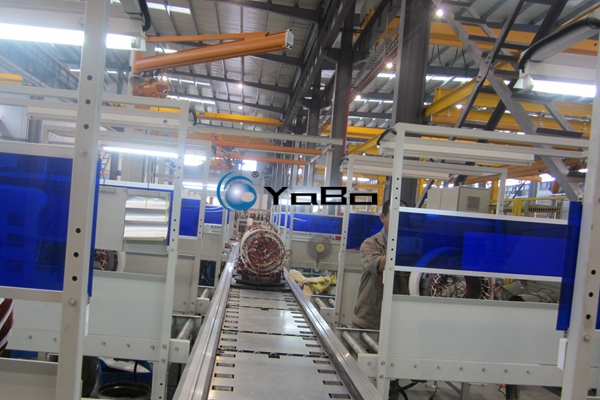
The motor assembly line employs a standardized linear conveyor layout that minimizes material handling distances while preventing cross-traffic between workstations. This optimized design allows components to enter at the production start point, progress through sequential operations, and emerge as finished products at the end, maintaining the shortest possible material flow path.
The system features a chain-driven pallet conveyor with precision positioning fixtures equipped with locating pins and clamping mechanisms that ensure consistent component alignment. Overhead, a yellow gantry structure functions as an inverted monorail conveyor system, transporting sub-assemblies directly to workstations. This three-dimensional logistics approach maximizes vertical space utilization while eliminating ground-level congestion, embodying lean manufacturing principles through point-of-use material delivery.
2. Assembly Process Sequence
Stator Preparation: Operations include laminated core assembly, slot insulation insertion, and copper winding installation. High-volume production lines typically combine automated winding processes with manual loading/unloading operations, supported by vacuum or ionized air cleaning stations that maintain winding insulation integrity.
Rotor Assembly and Dynamic Balancing: Rotating components undergo precise dynamic balancing with in-line balancing machines performing real-time unbalance measurements. The system automatically calculates and executes correction measures through drilling or weight adjustment, preventing unbalanced rotors from progressing to subsequent production stages.
Final Assembly Process: Stator-rotor mating requires maintenance of sub-millimeter air gaps, with advanced production lines utilizing guided insertion aids or robotic handling. End cover installation employs electric tightening spindles featuring torque-angle monitoring to ensure precise clamping force without housing deformation.
Electrical Connection and Testing: The process encompasses lead termination and terminal box installation, followed by comprehensive electrical testing covering insulation resistance, dielectric strength, and no-load performance. Modern automation systems execute these tests while binding data to individual motor serial numbers, with defective products triggering line stoppages or diversion to repair loops for error-proof quality control.
3. Production Control Systems
Takt Synchronization: All workstations operate within synchronized takt times, with immediate visibility of any production imbalances that drive continuous improvement initiatives. This real-time feedback mechanism provides operational insights unattainable in traditional batch production systems.
In-Process Quality Management: Repetitive operations cultivate operator quality intuition, supported by Andon systems that empower any team member to halt production for quality concerns. The integrated approach combines quick-change tooling, programmable torque equipment, and modular testing systems to enable rapid product changeovers between different motor specifications and configurations, meeting market demands for customization without compromising production efficiency.
EMAIL: yu.yblsx@gmail.com