
KYN28 Intelligent Assembly Line System
1. System Overview
The KYN28 Intelligent Assembly Line represents a modern manufacturing system specifically engineered for medium‑voltage switchgear production. Designed for assembling KYN28A‑12 withdrawable metal‑clad switchgear, this line integrates automated conveying technology with modular assembly processes to achieve complete production flow—from component loading to finished‑product shipment—significantly enhancing both manufacturing efficiency and product quality.
2. Line Structure and Layout
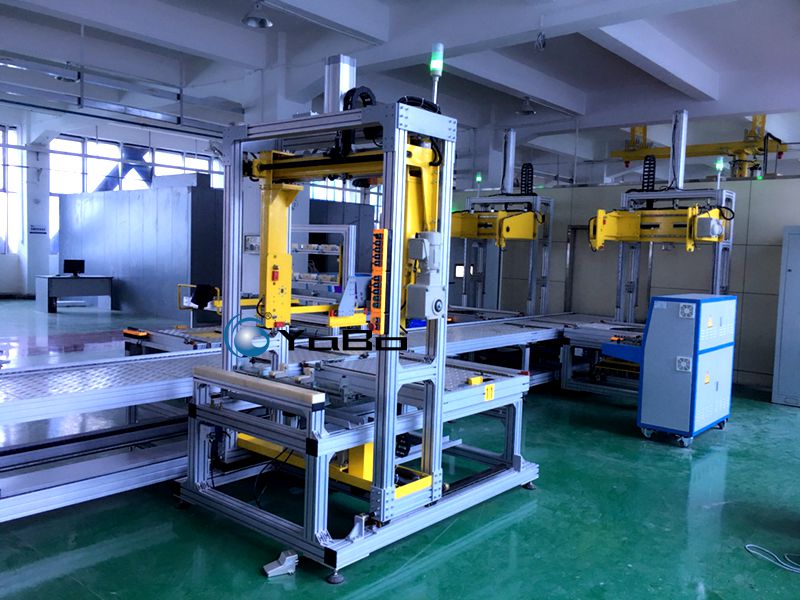
Featuring a segmented modular design, the assembly line connects multiple functional stations via chain‑plate conveyor platforms. Each platform is equipped with a blue anti‑slip surface and integrated guide rollers to ensure stable transport of switchgear enclosures between stations. Platforms are mounted on casters, enabling flexible reconfiguration and line expansion to suit various shop‑floor layouts.
Adjacent stations are separated by red safety barriers, which serve dual purposes: protecting operators and providing clear visual demarcation of work zones. Barrier heights comply with ergonomic standards, offering adequate protection without hindering material transfer or visual oversight.
3. Core Assembly Processes
The assembly sequence covers the essential manufacturing stages for KYN28 switchgear, organized as follows:
Station 1: Frame Pre‑Assembly
This station performs initial assembly of the switchgear frame, including positioning and fastening C‑section uprights, crossbeams, and base plates. Pneumatic clamping fixtures assist in alignment, ensuring frame geometry meets downstream tolerance requirements.
Station 2: Circuit‑Breaker Compartment Assembly
Here, breaker‑truck rails, shutter mechanisms, and interlocking devices are installed and adjusted. Given the precision required, concentricity deviation between the truck travel path and the stationary contact box must be kept within specified limits.
Station 3: Busbar and Cable Compartment Assembly
This stage includes main‑busbar copper connections, wall‑bushing mounting, earthing‑switch installation, and cable‑connection‑bracket setup. Copper joint surfaces receive tinning or silver‑plating treatment, with contact resistance verified in accordance with GB/T 11022 standards.
Station 4: Secondary Wiring
Terminal‑block installation in the instrument compartment, control‑harness routing, and protective‑relay wiring are carried out at this station. Harness runs follow a disciplined horizontal‑vertical layout, secured in dedicated cable channels with ties to maintain electromagnetic compatibility and ensure service accessibility.
Station 5: Integrated Testing and Inspection
Completed switchgear units undergo mechanical‑characteristic testing, insulation‑resistance measurement, main‑circuit‑resistance testing, and five‑safety‑interlock verification. Units that pass inspection are conveyed to the dispatch buffer area for packaging and shipment.
4. Material Flow and Conveyance
The line operates on a takt‑time production schedule, with all stations synchronized to a unified cycle. Conveyor‑platform speed is adjustable via variable‑frequency drives, accommodating different enclosure sizes and process complexities. Buffer zones between stations absorb timing variations, maintaining overall line stability.
For heavier cabinets, the platform’s roller surface allows manual‑assisted movement, reducing operator strain. The line supports both single‑unit flow and multi‑unit parallel‑assembly modes, making it suitable for both custom small‑batch and high‑volume production runs.
5. Quality Control Integration
Quality checkpoints are embedded at critical stages:
- Diagonal‑dimension verification after frame assembly
- Phase‑sequence marking and electrical‑clearance confirmation following busbar installation
- Power‑frequency withstand‑voltage and mechanical‑operation testing upon completion
This integrated quality‑assurance approach replaces traditional end‑of‑line inspection, enabling early defect detection and resolution.
6. Operational Value
Implementation of the KYN28 Intelligent Assembly Line has shifted switchgear production from traditional fixed‑station batch operations to continuous‑flow manufacturing. Line throughput has increased by approximately 40% compared to conventional methods, while first‑pass yield rates remain consistently high. The modular design also provides a clear upgrade path for further automation, with provisions for integrating automated fastening systems, machine‑vision inspection, and other advanced technologies to support the evolution toward a fully digital factory.
EMAIL: yu.yblsx@gmail.com