
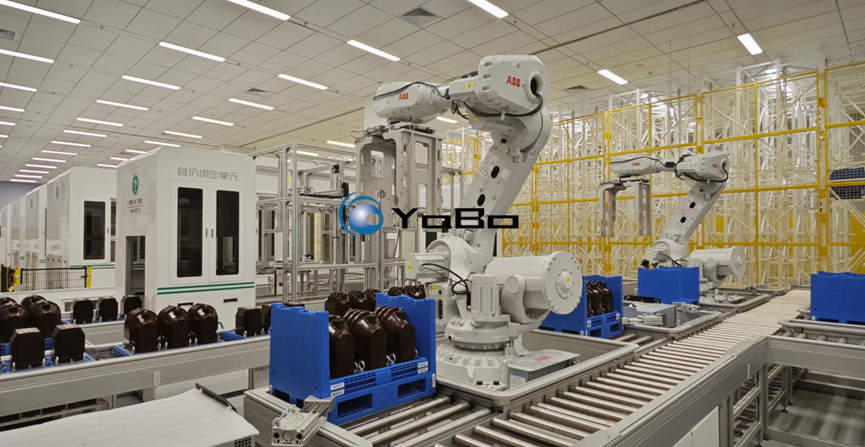
The photo shows a modular automated assembly production line for instrument transformers. The line is constructed using an aluminum profile framework combined with a flexible roller conveyor system. The entire production line consists of multiple independent functional workstations arranged in series along the roller conveyor; workpiece pallets circulate on the rollers to achieve precise transfer of transformer workpieces between processes. Several ABB six-axis industrial robots are visible on-site as core execution units, handling the搬运 and loading/unloading of transformer bodies. Specialized process equipment such as an “ID Binding Unit” is arranged on the left, while stereo warehouse shelves are located at the rear for intelligent material storage and supply. The line’s framework is primarily made of silver-gray industrial aluminum profiles, paired with blue material turnover bins. The clean workshop features a grid ceiling and LED panel lighting, with yellow safety isolation nets delineating operational zones, ensuring clear zoning for production management and safety isolation.
The production line adheres to a “unitized, scalable” design principle. Each functional module can be independently commissioned and quickly reconfigured or switched, supporting mixed-model production of current and voltage transformers of different specifications. The conveyor system supports variable frequency speed control; pallets carrying transformer workpieces flow between workstations according to a set production takt time. After completing all processes, pallets automatically return to the starting position via a circular return track, forming a closed-loop material logistics system.
II. Detailed Description of Core Process Units
2.1 Coil and Core Assembly Workstation
The electromagnetic conversion characteristics are the performance core of instrument transformers; coil winding and core preparation are critical processes in this production line. This workstation is equipped with automatic winding equipment that precisely controls enameled wire tension, number of winding turns, and interlayer insulation paper positioning accuracy to ensure transformer ratio precision. The cores are made of high-permeability grain-oriented silicon steel, typically manufactured into toroidal cores via a winding process, effectively reducing no-load losses and excitation current of the transformers.
Completed coils enter the insulation treatment station. Depending on the product type, VPI (Vacuum Pressure Impregnation) or epoxy resin vacuum casting processes are adopted to fully impregnate the insulation medium into the winding gaps, enhancing the insulation strength and moisture resistance of the transformers.
2.2 Automated Body Assembly Unit
This unit completes key processes such as insert pre-assembly for epoxy-cast transformer bodies. It is equipped with vibratory bowl feeders for automatic feeding, which sort standard parts like nuts and bolts and convey them via guide rails to the pick-up position. The line is configured with ABB heavy-duty six-axis robots that grasp inserts and complete their positioning and pre-assembly on the cast body.
An online inspection and rejection module is integrated at the end of the workstation. Relying on vision sensors and laser ranging for assembly quality inspection, defective products identified with misalignment, missing parts, or dimensional deviations are automatically diverted to a rework branch line, preventing them from flowing into downstream processes.
2.3 Terminal Tightening and Junction Box Cover Installation
The electrical reliability of transformer operation depends on the assembly quality of wiring terminals. This station is equipped with a servo electric tightening system; bolts are fed by vibratory bowl feeders and conveyed to the tightening station via guiding mechanisms. Servo screwdrivers complete locking according to preset torque parameters, ensuring consistent tightening processes for every bolt and avoiding over-tightening or under-tightening failures.
Workpieces flow to the junction box cover installation station, where covers are automatically sorted and fed. A robotic arm grasps the covers to complete snap-fit assembly, finalizing the protective assembly of the transformer body’s wiring section.
III. Conveying and Control Systems
3.1 Flexible Conveying System
The production line adopts a scheme of workpiece pallets + roller chain conveying. Pallets are equipped with dedicated Poka-Yoke fixtures to ensure repeatable positioning accuracy of transformer products at each workstation. The roller conveying speed can be dynamically adjusted according to the production takt time; each station is configured with stopper cylinders for precise pallet positioning. After processing is completed, the pallet is released, achieving takt-based production of “flow-stop-process-flow.” The main roller conveyor line is visible in the picture, with blue material turnover bins carrying transformer castings circulating along the conveyor.
3.2 Information Management and Control Platform
The entire production line is uniformly scheduled by a PLC + HMI control unit. All functional units are interconnected via Industrial Ethernet, reporting material status, equipment conditions, and quality data in real-time. The system features automatic sensing and fault interlocking functions: when an abnormality occurs at a certain workstation, that station and upstream processes automatically shut down and trigger audible/visual alarms to prevent WIP accumulation; during normal production, it strictly synchronizes the takt time of each unit to ensure line balance.
The production line can optionally be equipped with a MES (Manufacturing Execution System) to achieve full-process data traceability from raw materials to finished products. It can automatically record and archive key information such as winding parameters, insulation treatment process curves, tightening torque values, and inspection images. The “ID Binding Unit” shown in the figure completes the writing and binding of transformer product ID information, providing a data foundation for single-unit full-lifecycle traceability.
IV. Technical Features and Value
| Item | Technical Features |
|---|---|
| Precision Control | Precise control of winding turns; core preparation repeatable positioning error ±0.02 mm |
| Flexible Production | Modular workstations enable quick changeover, supporting mixed-model production of multi-specification transformers |
| Quality Assurance | Online visual inspection + automatic rejection of defects; full-process monitoring of torque and displacement at key processes |
| Data Traceability | Supports integration with MES systems to achieve full-lifecycle data traceability for individual products |
| Ergonomics | Automation handles repetitive, high-precision tasks; manual labor is limited to loading/unloading and re-inspection |
V. Application Prospects
This automated assembly line is widely used in the mass production of Current Transformers (CT) and Voltage Transformers (PT) for power systems, covering various structural types including molded case and cast resin types. With the advancement of smart grid construction, market demand for instrument transformers continues to grow. Automated production lines reduce manual intervention and improve assembly consistency, becoming a core means for cost reduction and efficiency enhancement in the industry. The line design also incorporates energy-saving and environmental protection concepts: optimizing silicon steel sheet nesting processes reduces scrap loss, and pairing with efficient curing equipment lowers energy consumption, aligning with green manufacturing development trends.
EMAIL: yu.yblsx@gmail.com