
Production line architecture: From rigid transportation to chassis technology innovation
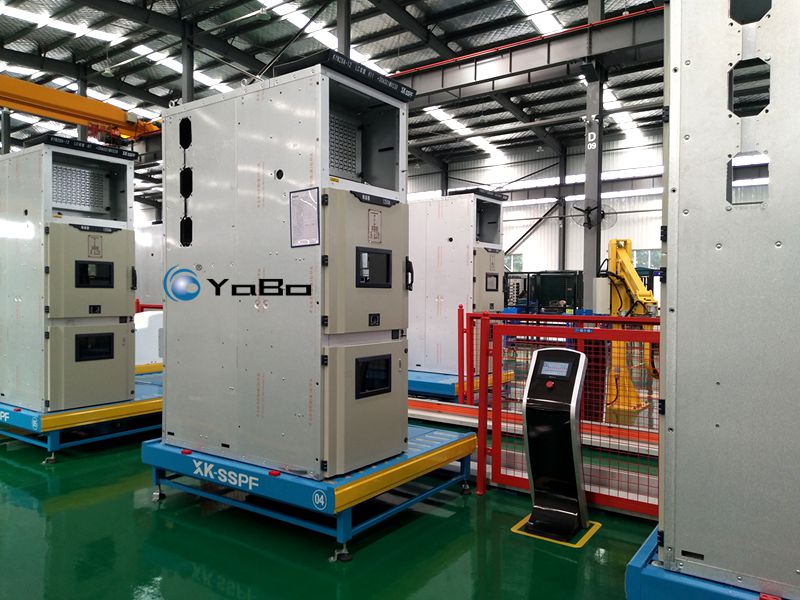
The picture shows a typical assembly line for high and low voltage switchgear. Its core feature is that it uses a pallet stacking and conveying system instead of a traditional conveyor belt. Inside the orange-yellow guardrail, the body of each switch cabinet is stably placed on a steel tray with a positioning device, and is driven by a chain or roller table to realize circulation between stations. This design stems from the special attributes of the switch cabinet-a single unit can weigh up to 300-800 kilograms, and the overall size is tall (usually 2-2.5 meters high). Traditional belt conveying cannot carry such heavy irregular workpieces. More critical is the application of the “Chassis Truck” process model. The switch cabinet frame is not built from scratch on the production line, but after the cabinet frame is welded and sprayed in the sheet metal workshop, it enters the assembly line in the form of a chassis. This means that the core tasks of the assembly line have changed to: component installation, busbar production and splicing, secondary loop wiring, and functional unit debugging. This division of labor of “modular pre-assembly + final assembly integration” decouples the logistics of heavy structural parts from precision electrical assembly, greatly improving rhythm efficiency.
Workplace technology: The game between high-pressure safety and precision assembly
Switch cabinet assembly is the intersection of high-voltage safety regulations and electrical precision processes. Each workstation carries strict technical constraints: Busbar processing and overlapping stations are the technical commanding heights of the production line. The copper and aluminum busbars need to be punched, bent, tinned or sheathed with heat shrink tube according to a system diagram, and the operator uses a hydraulic busbars processing machine to make them on-site. When overlapping, the contact surface must be coated with conductive paste, and the bolt is tightened with a torque wrench gradually applied in a crossed order to ensure that the contact resistance meets the GB standard-this is directly related to the temperature rise control and short circuit tolerance at the rated current. The functional unit extraction and loading station reflects the core characteristics of mid-mounted cabinets and drawer cabinets. Vacuum circuit breaker handcart, fuse handcart or drawer unit needs to complete guide rail alignment, primary contact box insertion, and secondary aviation plug docking under power failure. The workstation is equipped with positioning inspection tools that simulate the test position and the working position to ensure the reliable action of the mechanical interlock when the handcart is pushed. This is the basis of the “five-prevention” locking function. The secondary wiring station is the ultimate test of process precision. The control loop wires must be wired to the terminal strip according to the wire number tube identification. The wire harness runs horizontally and vertically, and the bending radius is not less than 6 times the outer diameter of the wire. The operator uses special tools such as wire stripping pliers and wire crimping pliers to ensure that the cold-pressed terminal is integrated with the wire. Any false connection may cause the protective device to operate incorrectly or refuse to operate.
Safety logic: electrical isolation system throughout the production line
The unique feature of the switchgear assembly line lies in the dynamic management of live and non-live states. A withstand voltage test area is usually set up at the end of the production line, but before this, all stations must be maintained in a safe state where they are completely free of electricity. This requires: Reliable electrical isolation breakpoints are set between workstations to prevent front-end test voltages from leaking into the assembly area The busbar overlapping station is equipped with grounding wire hanging contacts to prevent the risk of induced electricity or erroneous power transmission The test area and assembly area are separated by physical guardrails or safety gratings to achieve man-machine isolation The green epoxy floor laid on the floor of the production line is not only an aesthetic requirement, but also an anti-static requirement of 10^4-10^6Ω to avoid damage to secondary circuit electronic components caused by static electricity accumulation. Logistics beat: The time dimension of heavy manufacturing The assembly beat of switchgear is usually set at 30-60 minutes/set, which is much greater than the second beat of small household appliances. This determines that the production line adopts an asynchronous transfer mechanism-pallets can be independently stored at the station, and release is manually triggered after the current process is completed, rather than forced synchronous flow. This “flexible rhythm” adapts to the differences in assembly hours of cabinets with different specifications (incoming cabinets, feeder cabinets, PT cabinets, and metering cabinets). The compressed air pipe network and tooling power sockets above the production line are arranged along the entire line, providing plug-and-play energy interfaces for pneumatic tools, busbar processing equipment, and temporary lighting, reducing the interference of ground pipelines on heavy logistics. From the entry of the sheet metal chassis to the withstand voltage of the whole machine, the switchgear assembly line is a physical presentation of heavy-duty structural mechanics, high-voltage insulation technology, and electrical protection principles. When the pallet carries a cabinet several meters high and moves smoothly under the drive of a chain, each pause is the construction of a precision electrical system, and each release is a progress towards the commitment to safe operation of the power grid. This is the essence of transmission and distribution equipment manufacturing-to protect the safety of the power system with the certainty of industrialization.
EMAIL: yu.yblsx@gmail.com