
1. Production line structure: pay equal attention to flexibility and standardization
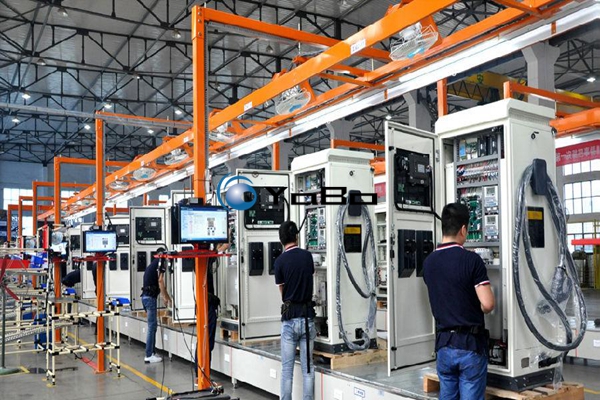
It can be seen from the production site that the modern charging pile assembly line adopts a modular steel structure frame system. Orange aluminum alloy or steel columns and beams form the production line skeleton, which not only ensures the bearing strength of the overall structure, but also facilitates rapid expansion or reorganization in the later period according to production capacity requirements. This open frame design supports the integrated layout of suspended conveying systems, workstation lighting, air source pipelines and information networks, maximizing the space efficiency of “one column for multiple purposes.” The production line adopts a segmented layout, usually covering four functional modules: pre-assembly section, final assembly section, testing section and packaging section. The sections are connected by roller conveyor lines or AGVs to form a flexible logistics channel. The spacing between stations is scientifically set according to the work content-sufficient operating depth is reserved for the electrical installation station, and independent shielding space is provided for the test station to avoid electromagnetic interference. This functional zoning not only ensures the smoothness of operations, but also provides the possibility of mixed-line production of different types of charging piles.
2. Core assembly process: precise transformation from structural parts to complete machines
The first process of the structural pre-assembly process completes the modular assembly of the charging pile cabinet. After the sheet metal shell is laser cut and CNC bent, the frame splicing, hinge positioning and door lock pre-adjustment are carried out on a special fixture. At this stage, the focus is on controlling flatness and diagonal accuracy to ensure the sealing performance of subsequent door closure. The sealing strip is embedded with guide groove auxiliary tools to ensure uniform and consistent compression and meet the protection level requirements of IP54 and above. Electrical system integration process This is a technology-intensive part of the production line. The operators complete the following processes in the semi-open workstation: slide-mounted power modules (20kW-40kW single group), plugging the main control board and the communication board, layout of AC and DC contactors and fuses, and lapping copper bar buses. Cable routing follows the principle of “layered and slotted”-power wires and signal wires are physically isolated, high-voltage wiring harnesses are equipped with bellows protection, and the grounding system is connected with yellow and green two-color signs throughout the process. Torque control is implemented at key connection points, and 100% conduction test and insulation resistance test are carried out. The electrical units assembled through the charging module joint debugging process enter the on-load aging test station. The characteristics of electric vehicle batteries are simulated by programmable DC loads to verify the output voltage and current accuracy (usually within ±0.5%), ripple coefficient and efficiency curve of the charging module. At the same time, detect the response sensitivity of multiple protection functions such as overvoltage, overcurrent, and overtemperature, and eliminate early failure products. The complete machine function verification process final inspection station deploys a comprehensive test platform to simulate the complete charging session process: from gun head plugging to BMS handshake communication, from dynamic adjustment of power output to real-time feedback of SOC status, from billing settlement to remote monitoring data upload. Test data is automatically written to the MES system to generate a unique identity traceability code.
3. Technical characteristics of the production line: dual guarantee of efficiency and quality
Modern charging pile assembly lines deeply integrate lean manufacturing concepts.The workstation is equipped with visual electronic signage that displays work instructions (SOPs), quality warnings and production beats in real time; key workstations are equipped with error-preventing devices, such as material shortage sensing, missed installation detection and torque feedback systems; the tooling and fixtures adopt a quick-change design to support Product model switching is completed within 30 minutes. At the level of quality control, the production line has built a three-level inspection system: operator self-inspection, inspector process random inspection, and full-functional testing on the final inspection bench. Safety interlocks and warning isolation are set up in the high-voltage test area to ensure the safety of personnel operations. In terms of environmental control, the electronic component assembly area maintains constant temperature and humidity, and the ESD electrostatic protection ground resistance is less than 1Ω, comprehensively ensuring the reliability of power semiconductor devices. conclusion The charging pile assembly line is not only a simple combination of equipment and workstations, but also a system integration of electrical technology, automation engineering and manufacturing management. Every transformation from sheet metal parts to smart charging terminals is achieved through this precision-running manufacturing artery. With the popularization of 800V high-voltage fast charging technology, assembly lines will continue to evolve in the direction of high flexibility, high tempo, and high intelligence, providing solid support for the large-scale deployment of new energy infrastructure.
EMAIL: yu.yblsx@gmail.com