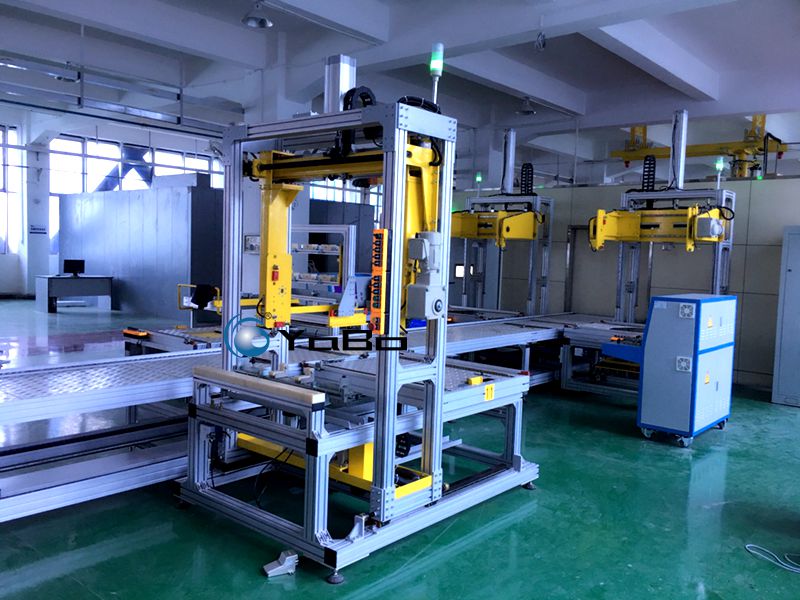

Indoor high-voltage vacuum circuit breakers are the core switching components in high-voltage switchgear such as KYN28-12, KYN61, and XGN series. They play a critical role in power distribution systems by handling load current switching and short-circuit protection. The VS1-12, being the most widely used indoor vacuum circuit breaker, consists of numerous components; its poles and operating mechanisms are heavy, demanding high precision in assembly processes. A reliable circuit breaker assembly line ensures consistent product quality and meets the demands of batch manufacturing.
This production line is designed for medium-volume manufacturing scenarios and represents an upgraded high-voltage circuit breaker assembly line. Building upon the proven foundation of double-speed chain pallet conveyance, it integrates gantry-type servo-driven transfer and pressing units specifically to address the challenges associated with handling and pressing heavy components of circuit breakers. Adopting a human-machine collaborative approach, this line eliminates reliance on manual hoists for heavy-duty operations, making it ideal for medium-to-large-scale high-voltage switchgear manufacturing workshops.
I. Line Structure and Facility Configuration
1. Double-Speed Chain Conveyor Section
The main body of the line utilizes aluminum alloy profiles to construct a double-speed chain assembly line, a standard conveying structure for circuit breaker production lines. Complete circuit breakers are placed on dedicated tooling pallets and transported between workstations via chain drive. Each workstation is equipped with a stopping mechanism that locks the pallet securely in place upon arrival, ensuring stability during assembly and pressing operations before releasing it to proceed to the next station.
The line natively supports tooling pallets for various specifications of VS1-12 withdrawable circuit breakers. With replacement positioning fixtures, it can also accommodate other indoor circuit breakers of the same voltage class, such as VD4 and ZN28-12.
2. Gantry Servo Transfer and Pressing Workstation
This unit represents the core upgrade of the production line. The yellow gantry mechanism shown serves as the servo-driven transfer and pressing unit. It is primarily utilized for lifting, shifting, aligning, and pressing heavy components such as vacuum interrupters, solid-insulated poles, and operating mechanisms within the workstation.
It replaces traditional manual hoisting and lifting methods, significantly reducing labor intensity associated with assembling large components. During the pressing phase, parameters such as pressure and stroke can be directly controlled, ensuring uniformity in the assembly state of poles and transmission parts while minimizing deviations caused by manual operation. Multiple gantry units can be arranged along the line to handle different processes, such as pole assembly and mechanism pressing; supporting pneumatic and hydraulic power cabinets provide the necessary power output for the entire pressing system.
3. Manual Operation Workstations
Manual operation workstations are arranged on both sides of the line. After the gantry mechanism completes the positioning and pressing of major components, personnel perform fine assembly tasks such as fastening, wiring, and installing small parts. Ample operating space is provided at each workstation to accommodate torque wrenches, various fixtures, and measuring tools, facilitating the assembly of multi-component circuit breakers.
4. Workstation Display Terminals
Each workstation is equipped with a suspended industrial display screen showing process BOM lists, assembly drawings, pressing process parameters, and on-site operational requirements. Operators conduct their work referencing these electronic process instructions. At pressing stations, operators can also retrieve pressing curves and view operation records, enabling full traceability of the assembly process and replacing paper-based process cards.
5. Lineside Material Handling Facilities
Material bins and lineside turnover carts are positioned adjacent to workstations for organized storage of scattered components such as contacts, springs, fasteners, and secondary connectors. Placing materials in close proximity reduces unnecessary movement for workers, maintains workstation tidiness, and supports continuous flow production.
II. Core Assembly Process Flow
This assembly line focuses on the production of indoor high-voltage circuit breakers, primarily targeting the VS1-12 indoor vacuum circuit breaker. By changing tooling pallets and positioning fixtures, it can be expanded to support VD4 and ZN28-12 indoor circuit breakers, catering to the production needs of circuit breakers compatible with KYN28-12, KYN61, and XGN series switchgear.
- Mechanism Component Pre-assembly
Tooling pallets enter the line for pre-assembly and debugging of spring operating mechanisms, main shafts, and crank-linkage assemblies. All transmission components are inspected for proper movement, confirming smooth energy storage and opening/closing operations without jamming. - Automatic Gantry Transfer and Pressing
The gantry transfer mechanism lifts and aligns solid-insulated poles or vacuum interrupter assemblies for pressing and fastening. Subsequently, conductive components such as contact arms, plum-blossom contacts, and upper/lower outlet terminals are assembled, with all connections tightened according to specified torque standards. - Secondary Circuit Wiring
Personnel complete wiring for secondary components including auxiliary switches, opening/closing coils, travel switches, and aviation plugs, ensuring secure connections and clear, complete wire identification. - Mechanical Characteristic Testing
Using a mechanical characteristic tester, key indicators such as opening/closing time, contact separation/make speed, contact gap, over-travel, and three-phase synchronization are measured to verify the overall mechanical performance of the unit. - Electrical Performance Factory Acceptance Test
Tests including main circuit DC resistance, power frequency withstand voltage, and insulation resistance are conducted sequentially to identify poor contact or insulation defects, ensuring all product metrics meet factory acceptance test standards. - Final Inspection and Off-line
A comprehensive re-inspection covers fastener tightness, appearance, and actual operational performance. Nameplates and various accessories are installed. Qualified units are conveyed off-line via pallets to the packaging and warehousing process.
III. Line Features
- Automation of Heavy-Duty Operations
Leveraging gantry servo transfer and pressing mechanisms, the line resolves difficulties in handling and pressing heavy components like poles and operating mechanisms, reducing worker fatigue. Pressing parameters are monitored, resulting in superior assembly consistency compared to purely manual circuit breaker assembly lines. - Proven Reliability of Double-Speed Chain System
Utilizing the industry-standard double-speed chain pallet conveyance architecture, the system features minimal failure points and simple maintenance, offering an upgraded solution for high-voltage circuit breaker lines that balances performance with reliability. - Human-Machine Collaborative Production
Heavy lifting and pressing are handled by equipment, while fine assembly and wiring remain manual tasks. Rather than pursuing full automation, this approach suits medium-volume, high-mix production models for indoor circuit breakers. - Moderate Investment with Enhanced Output
While requiring higher capital investment than basic manual assembly lines, the overall cost remains controllable compared to fully automated unmanned lines. This makes it an ideal choice for switchgear manufacturers with stable production volumes seeking to alleviate heavy physical labor on the shop floor.