

1. Overview
An oil-immersed transformer uses transformer oil as the insulating and cooling medium; oil convection keeps the windings and core within working temperature. It is core substation equipment for distribution networks, renewable-energy step-up and industrial power supply. Distribution-class units are typically fully sealed S11-M, S13-M and S15-M oil-immersed transformers rated 30 kVA–2500 kVA for 10 kV networks and commercial/industrial sites; power-class units cover 2500 kVA–63 MVA for substations and renewable step-up applications. Downstream sectors include grid distribution, PV/wind box-type step-up transformers, energy-storage transformers and special units for metallurgy and chemicals, each with different demands on assembly consistency, short-circuit withstand and noise level.
The active part (core & coil assembly) is heavy: roughly 0.5–4 t for distribution-class units and 3–15 t for power-class units. Light belt conveyors and ordinary roller lines cannot handle continuous assembly of such loads; a heavy-duty pallet conveying system is required.
Transformer assembly lines fall into three main conveying types: fixed-station crane build, where the workpiece is repeatedly lifted at one station (low automation, higher safety risk, suitable for small batches of very large units); chain pallet conveyors, which are strong but suffer from start/stop impact, poor positioning accuracy and chain wear; and heavy-duty roller conveyor pallet lines — sectional powered rollers with dedicated work pallets, intermittent conveying, smooth running and precise station locking, able to integrate assembly, testing, buffering and turning stations.
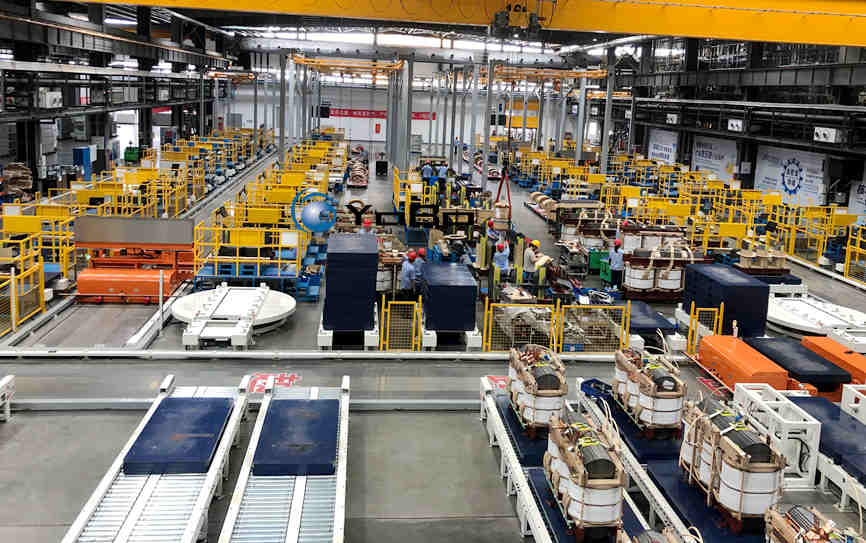
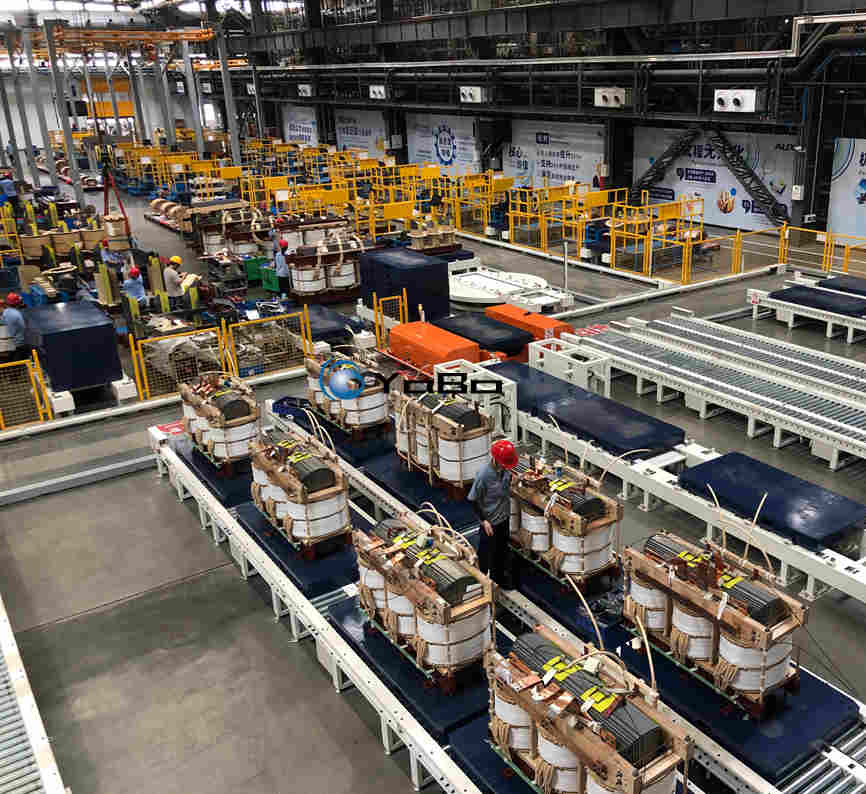
This oil-immersed transformer assembly line uses the heavy-duty roller pallet concept in an intermittent loop, designed for batch production of fully sealed S11/S13 distribution transformers. The active part travels on heavy work pallets and moves station to station via powered rollers, with rotary assembly stations, buffer stations and load/unload stations; overhead cranes handle core and winding lifting, and the line can be integrated with MES for work-order scanning, process anti-error control and production data collection. It eliminates repeated lifting, restricted working angles, missing traceability and man-machine crossing hazards. This line covers the active-part assembly section; tank fitting, vacuum drying, vacuum oil filling and sealing tests are separate downstream stations.
2. Assembly Process
The oil-immersed transformer production line organizes active-part assembly by station with a fixed takt:
- Active part loading: the core & coil subassembly is lifted by overhead crane onto the heavy work pallet, clamped and located; the pallet is scanned and bound to the work order, and BOM/process parameters for that unit are issued.
- Active part dressing & insulation: the part is conveyed to a fixed assembly station and locked; insulation spacers are secured, core earthing assembled, winding binding reinforced, insulation distances verified and metal burrs removed to avoid partial-discharge risks.
- Lead welding & tap changer pre-fitting: the part enters the rotary station where the pallet can rotate 0–360°, allowing multi-angle welding of HV/LV leads, tap changer fitting, lead clamping and insulation wrapping, plus connection dimension checking — no repeated crane lifting.
- Insulation testing: the part is locked at the test station for insulation resistance and DC resistance pre-tests; failed units are buffered and isolated on site, not allowed into the next process.
- Buffering: qualified units enter the roller buffer zone to balance takt differences between stations and prevent line blockage.
- Offloading: qualified active parts are lifted off the pallet by crane to tank fitting, vacuum drying and vacuum oil filling; empty pallets return automatically via rollers to the loading station.
The line runs in intermittent mode — conveying is released only after the current station’s work is finished and manually confirmed — matching the “slow takt, high reliability” requirement of power equipment assembly. Every station is equipped with safety fencing and area light-curtain interlocking; rollers stop automatically when station doors open.
3. Customizable Parameters
This oil-immersed transformer assembly line is custom-built non-standard equipment. The following are reference standard values with customizable ranges; the final design follows your actual scheme:
| No. | Parameter | Standard Config | Custom Range | Note |
|---|---|---|---|---|
| 1 | Operation mode | Sectional powered roller conveyor with pallets, intermittent loop | Continuous / intermittent indexing | Intermittent + station locking recommended for precision assembly |
| 2 | Pallet rated load | 8 t | 3–15 t | Select by active-part weight: ~0.5–4 t distribution class, 3–15 t power class |
| 3 | Roller spec | Φ114 mm heavy-wall seamless carbon steel | Φ89 / 114 / 140 mm | Surface-hardened for heavy-duty service |
| 4 | Roller pitch | 150 mm | 120–200 mm | Smaller pitch for large units to limit pallet deflection |
| 5 | Conveying speed | 0.5 m/min | 0.2–1.5 m/min VFD | Slow at assembly stations, faster in buffer zones |
| 6 | Work pallet | 2400 × 1600 mm | Custom, up to 4000 × 2200 mm | Welded steel pallet with locating pins and stops |
| 7 | Drive | Sectional motor + sprocket | Motorized rollers / gear drive | Sectional drive lowers traction on long lines |
| 8 | Stations | Loading, assembly, rotary, testing, buffer, return (6 types) | Add/remove stations, lift-transfer & turning units | Rotary station 0–360° powered |
| 9 | Positioning accuracy | ±3 mm | ±1–±5 mm | Mechanical stop + photoelectric double locking |
| 10 | Control system | PLC + HMI | Profinet / Modbus TCP to MES (RS485 optional) | Work-order scanning, process anti-error, data upload |
| 11 | Frame material | Q235, sandblasted + epoxy coating | Hot-dip galvanized | For dusty / humid workshops |
| 12 | Safety | Fencing, light curtain, E-stop, audible/visual alarm | Safety mats, zone interlock, safety door locks | Man-machine isolation at all stations |
| 13 | Ambient temperature | 5–40 °C | −10–50 °C version | Low-temperature motor option for cold shops |
| 14 | Line length | Per layout | 20–120 m per line | Sectional control, phased expansion |
4. Flexibility & Extension
By changing stop blocks and locating components, one line can run mixed production of multiple active-part sizes within the rated range. Soft start / soft stop logic reduces start-stop impact on winding insulation; the modular design supports adding stations and extending the line later, lowering second-phase expansion cost. If you are planning a new or upgraded transformer production line, this system can be implemented in phases according to shop-floor span and target output.