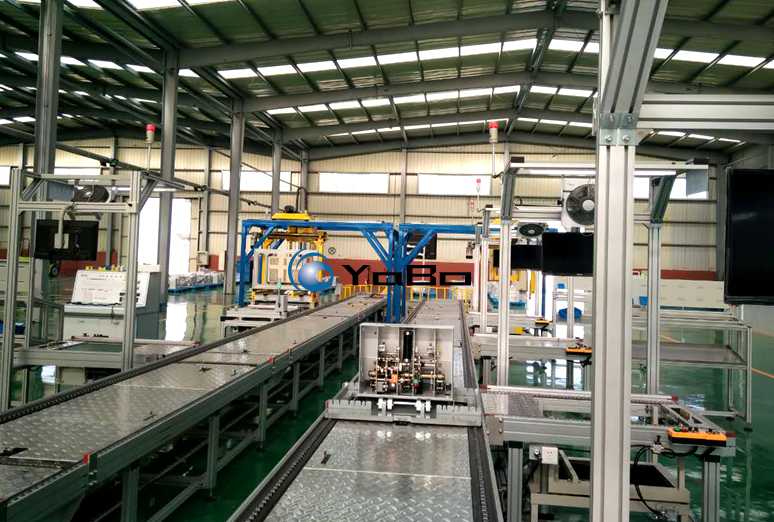

This production line is a speed‑multiplier chain assembly line tailored for the assembly of indoor high‑voltage vacuum circuit breakers. It is a classic, cost‑effective and practical production‑line equipment for high‑voltage circuit breakers in the industry. The whole production line relies mainly on manual assembly supplemented by equipment conveyance. It adopts the proven configuration of simple speed‑multiplier chain plus ball‑transfer platform, without complex automated mechanisms. Featuring a compact and robust structure, it is specially designed for batch assembly of indoor high‑voltage circuit breakers and widely deployed in complete‑set high‑voltage switchgear manufacturing workshops.
I. Line Structure and Facility Configuration
1. Speed‑Multiplier Chain Conveying Section
The main body of the line adopts industrial aluminum profiles to build a standard speed‑multiplier‑chain assembly structure, which represents the most mainstream conveying form for circuit‑breaker assembly lines. Complete circuit breakers are placed on custom‑made tooling pallets and conveyed sequentially between workstations driven by chains.
A core advantage of the speed‑multiplier chain is that when a workstation stops, the tooling pallet can disengage and lock from the running chain, keeping the workstation stationary. This facilitates stable assembly, tightening and wiring operations by workers. Upon completion of one process, pallets can be quickly released to the next workstation. Balancing assembly accuracy and production tact time, it fully meets the assembly‑process requirements for VS1‑12/R8 indoor circuit breakers.
2. Ball‑Transfer Transition Section
Ball‑transfer platforms are applied for all diverging, converging, turning and connecting positions of the production line. Workers may manually push tooling pallets to realize flexible translation, turning and position adjustment.
Eliminating complex mechanisms such as lifting‑and‑shifting and lifting‑transfer units, this minimalist mechanical design enables flexible multi‑workstation connection with extremely low failure rate and easy maintenance. It is a practical and proven solution for economical high‑voltage circuit‑breaker assembly lines.
3. Side‑Mounted Fixed Operation Benches
Fixed work platforms are installed on both sides of the line as primary assembly stations. After pallets are precisely positioned and locked, workers can perform delicate operations including mechanism pre‑assembly, component press‑fitting, screw tightening and secondary wiring on solid benches. The flat and stable work surface can hold hand tools, torque wrenches and measuring instruments directly, improving operation comfort, assembly standardization and working efficiency.
4. Workstation Display Terminals
Each workstation is equipped with a suspended display terminal, which real‑time displays assembly drawings, operation standards, process parameters and part lists for corresponding processes. Operators follow digital process documents on‑site instead of traditional paper‑based process cards, avoiding drawing loss and version confusion, and achieving unified, standardized and traceable on‑site processes.
5. Auxiliary Material‑Handling Facilities
Multi‑layer material bins and line‑side turnover trolleys are standard on both sides of each workstation, for orderly storage of small assembly components such as interrupter accessories, contacts, springs, insulating parts and standard fasteners. Parts are placed within easy reach, greatly reducing workers’ material‑fetching travel time, keeping workstations neat and tidy, and supporting continuous pipeline‑mode production.
II. Core Assembly Process Flow
Dedicated to indoor high‑voltage circuit‑breaker assembly, this line is primarily optimized for new‑generation indoor vacuum circuit breakers. With replacement of special tooling and fixtures, it also supports assembly of indoor circuit breakers at equivalent voltage levels such as VD4 and ZN28, fully satisfying production requirements for circuit breakers matching KYN28‑12, KYN61 and XGN series high‑voltage switchgears. The core process forms a complete closed loop:
1. Mechanism and Transmission Pre‑assembly
Front‑end workstations of the production line carry out pre‑assembly and commissioning of spring operating mechanisms, main shafts, transmission cranks and connecting‑rod assemblies. Matching clearances of all rotating and transmission components are strictly controlled to ensure flexible, smooth energy‑storage, closing and opening actions without jamming or abnormal noise, so as to guarantee qualified fundamental mechanical performance of circuit breakers.
2. Interrupter and Pole‑column Installation
Solid‑encapsulated pole‑columns or assembled pole‑columns and vacuum interrupter assemblies are precisely positioned and mounted onto the circuit‑breaker base box, with fixing bolts tightened. Conductive components including upper‑and‑lower outlet bases, contact arms and tulip contacts are assembled in sequence and fastened with specified torque throughout the process to ensure tight and reliable connections of the conductive circuit.
3. Secondary Control‑Circuit Wiring
In accordance with electrical schematic diagrams and wiring specifications, wiring is completed for secondary components such as auxiliary switches, microswitches, travel switches, closing‑opening coils and aviation connectors. Wiring shall be neatly routed, firmly connected and clearly marked, ensuring error‑free connections for both control and signal circuits.
4. Mechanical‑Characteristic Testing
After assembly, a professional mechanical‑characteristic tester is used to measure key mechanical parameters: opening‑closing time, instant make‑and‑break speed, contact gap, over‑travel and three‑phase synchronism. These quantitative measurements verify mechanism‑action accuracy and screen out non‑conforming assembled units.
5. Electrical‑Performance Test
DC resistance test for main circuits, power‑frequency withstand‑voltage test and insulation‑resistance test are performed sequentially to detect poor circuit contact and hidden insulation defects. This ensures circuit breakers meet electrical‑performance requirements and factory‑test standards for stable operation with various 10 kV indoor high‑voltage switchgears.
6. Final Inspection and Off‑line
Comprehensive re‑inspection is performed on fastening status of all fasteners, overall appearance, operating performance and wiring standardization. Nameplates and protective accessories are fitted. Fully qualified complete units are smoothly off‑loaded from the line end for re‑inspection, packaging and warehousing.
III. Line Features
- Simple and Stable Structure Built upon the mature combined solution of speed‑multiplier‑chain conveyance plus ball‑transfer transition, the equipment features simple mechanics, few fault points and convenient routine maintenance. It serves as a preferred configuration for high‑voltage circuit‑breaker assembly lines in small‑and‑medium‑size switchgear manufacturers.
- Controllable Investment Cost Free of high‑end servo systems, automatic transfer units and fully‑automatic testing mechanisms, the line features low equipment procurement and operation‑maintenance costs. It requires low entry‑level investment and delivers fast return, suitable for small‑to‑medium‑batch and multi‑lot production of indoor circuit breakers.
- Excellent Human‑Machine Compatibility Centered on precise manual assembly and supported by pipeline conveyance, the line achieves tact‑time‑based workstation production while reserving sufficient room for manual adjustment. It is highly suitable for flexible assembly of multiple‑model indoor high‑voltage circuit breakers.