

1. Product Overview
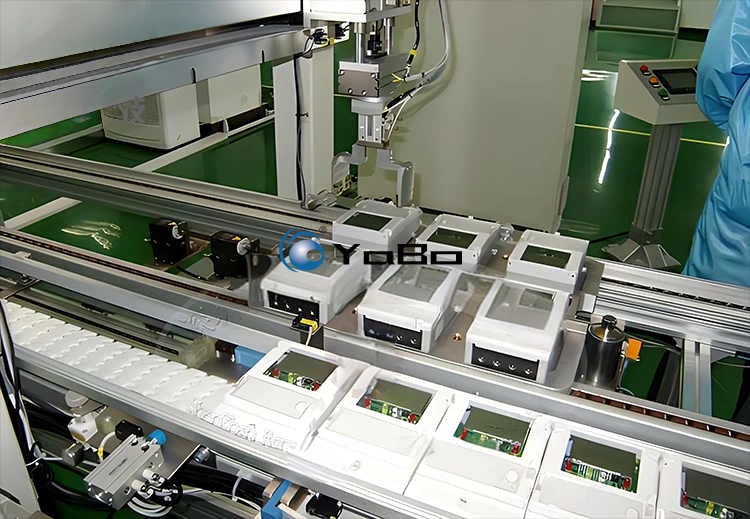
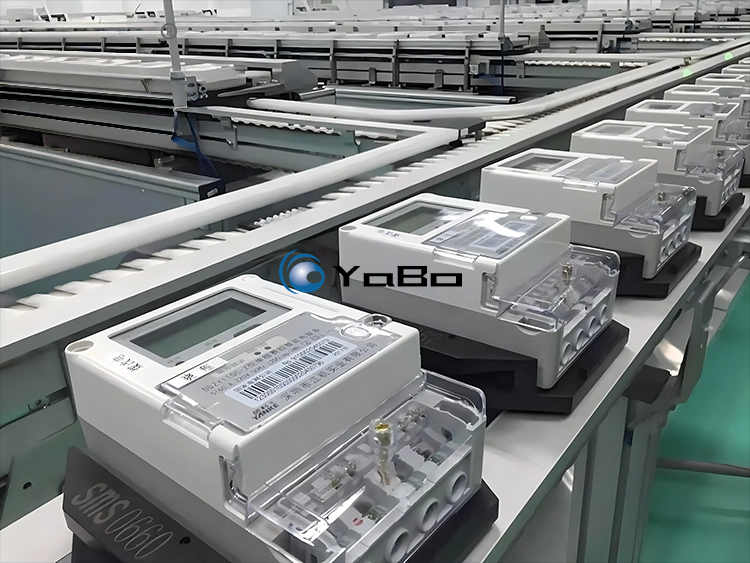
The electricity meter assembly line is designed for large‑scale and standardized production of single‑phase and three‑phase smart electricity meters. Centered on an industrial‑grade speed‑multiplying chain conveyor system, the production line skillfully integrates precision machinery, pneumatic control, electrical automation and information management technologies. It enables continuous and automatic assembly as well as in‑line testing of electricity meters. Featuring high flexibility and expandability, the line supports mixed‑model production of various meter types.
2. Core Technical Parameters
2.1 Mechanical and Conveying System
Conveyor track: Guide rails are made of special anodized aluminum profiles with excellent rigidity and wear resistance.
Line width: 400 mm‑1200 mm (customized according to tooling pallet and meter dimensions; the typical width for single‑row assembly line is approximately 620 mm).
Line height: Standard working height is 750 mm with an adjustment range of 500 mm‑1000 mm, complying with ergonomic requirements.
Conveying speed: 2‑20 m/min with variable‑frequency stepless speed regulation for freely‑configurable production cycle time.
Speed‑multiplying chain system: Special differential chains of 2.5‑speed (BS25) or 3‑speed (BS30) with a standard pitch of 38.1 mm, delivering fast and smooth transportation of tooling pallets.
Tooling pallet material: High‑strength bakelite board, engineering PP plastic or custom steel plate. Anti‑static or wear‑resistant surface treatment is available.
2.2 Electrical and Control System
Control core: Main control unit adopts PLC series from Mitsubishi, Siemens or Delta, integrated with industrial touch‑screen HMI.
Drive unit: Equipped with high‑quality brand geared motors and frequency converters for accurate start‑stop and speed control.
Positioning accuracy: Pneumatic stoppers combined with photoelectric sensors achieve tooling pallet positioning accuracy ≤ ±0.5 mm.
Power supply mode: Conductive rails are embedded in line guide rails, and conductive wheels are mounted at the bottom of tooling pallets to realize powered conveying along the whole line, meeting requirements for in‑line aging and power‑on testing.
2.3 Pneumatic and Safety System
Air source requirement: Compressed air at 0.4‑0.6 MPa.
Pneumatic components: Well‑known brand components such as Airtac stopping cylinders, lifting cylinders and solenoid valves for fast and reliable actuation.
Safety features: Full‑line emergency stop pull‑cord switches, earth‑leakage circuit breakers, over‑temperature / overload protection and transparent acrylic safety guards.
3. Standard Functional Configuration
Smart tooling circulation: Tooling pallets circulate via the speed‑multiplying chain. Electric‑controlled pneumatic stoppers realize accurate accumulation and stop at each workstation.
In‑line assembly workstations: Semi‑automatic or fully‑automatic dedicated stations including automatic crimping, automatic screw tightening (servo / electric screwdriver), and PCB board insertion guidance.
Power‑on testing and aging: Independent power‑on test zone in the middle or at the end of the line, equipped with programmable power supplies, multi‑function reference meters and hipot & insulation testers for full inspection of error calibration and communication functions.
Information traceability (optional): Workstation terminals integrate barcode scanners to read meter barcodes / RFID tags in real time. Production and test data are bound to the unique product ID and uploaded to the MES (Manufacturing Execution System).
Auxiliary facilities: Standard full‑line LED lighting, multi‑function power sockets (220 V / 24 V), process instruction display boards, tool hooks and quick pneumatic connectors.
4. Typical Process Flow
Feeding (housing / PCB / module) → Crimping & Assembly → Screw Tightening → Dispensing / Sealing → Semi‑finished Product Power‑on Test → Display & Keypad Assembly → Complete‑meter Calibration & Retest → Laser Marking / Labeling → Final Visual Inspection → Automatic Unloading
5. Equipment Advantages
High stability: Differential speed‑multiplying chain conveying ensures smooth operation, low noise (<70 dB) and extremely low failure rate.
Flexible manufacturing: Quick adaptation to meters of different sizes by replacing tooling pallets and adjusting stopper positions; model change‑over time < 30 minutes.
High production capacity: Over 30 % increase in effective working time compared with traditional belt conveyors. Single‑shift capacity can reach 800‑1500 units per hour subject to cycle‑time design.
Note: The above parameters are based on industry standards and typical configurations for electricity meters. Specific dimensions, speed and automation level can be non‑standard customized according to customer‑site plant layout and process requirements.